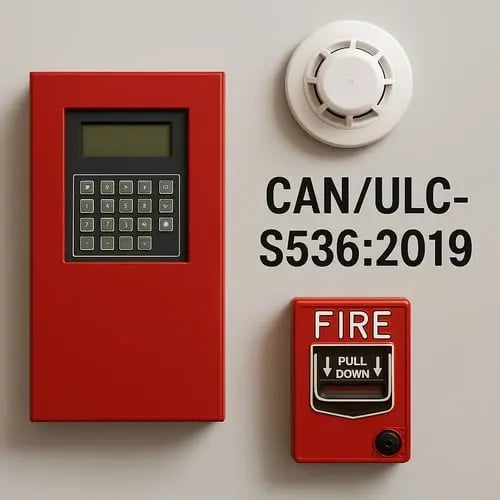
Property owners, managers and business owners should be aware that CAN/ULC-S536:2019 Fire Alarm Inspection and Testing Standard is now being actively enforced across Ontario for annual fire alarm inspections.
This updated standard introduces more comprehensive inspection and documentation requirements than previous versions. Technicians are now required to complete additional verification steps, expanded testing procedures, and more detailed reporting for each fire alarm system component. The goal of these changes is to improve overall life safety by ensuring that fire alarm systems are tested, documented, and verified to a higher level of accuracy and accountability.
Because of these new requirements, the inspection process and the preparation of final reports may take longer than in previous years. While the testing itself remains familiar, the level of detail required in the inspection documentation has significantly increased.
Whats New in CAN/ULC-S536:2019 (Ontario 2026)?
- Deeper, device-level testing. More steps for control units, power supplies, voice systems, wireless/air-sampling/CO devices, & circuit supervision.
- New battery test method. Moves beyond a simple voltage check to a load/functional test with recorded values
- Mandatory report forms. The standard official annual & monthly forms are now required – no shortened checklists.
- Clear deficiency vs. recommendation. Deficiencies MUST be corrected, recommendations are optional improvements
- Attendance & accountability. Technician names, dates, times on site recorded; owner acknowledgment captured
- Monthly logs formalized. A defined form/log for monthly checks is part of your compliance record – please contact us if you would like to use provide a monthly inspection service for you!
- Bottom Line: Inspections will be more thorough and take longer. Plan for added time and documentation, especially in high-rise and mixed-use buildings.
Due to this change, please expect inspections to take anywhere from 20-30% longer – this is an additional cost at the customers expense.
What This Means for Owners & Property Managers?
- Longer service windows. Allow more time per annual inspection; complex sites may span multiple visits.
- Suite access planning. Device-level testing increases the need for coordinated entry in residential towers – note that we always require a representative from management to enter tenant units.
- Monthly discipline. Ensure monthly checks are done and logged on the correct form – we offer hard cover books or printable versions.
- Budget & contracts. Expect higher inspection effort. Many portfolios see ~20-35% more labour/time under S536-2019.
- Update service agreements. Specify compliance with CAN/ULC-S536:2019 & delivery of the official report forms.
- Allocate for fixes. Deeper testing finds more issues; set aside funds to clear deficiencies quickly to avoid costly fines.
- Risk & governance. Fewer gray areas. Deficiencies are unambiguous – and must be corrected.
- AMPs (fines) possible. AHJs (Authority Having Jurisdiction) can issue penalties for missed/insufficient inspections and uncorrected hazards.
- Insurance readiness. Clean, standardized reports support underwriting and claims.
- Scheduling & Budget Planning (At-A-Glance)
- Typical annual test effort: 2025 = %100
- Typical annual test effort: 2026 = ~%130
At our company, we are committed to ensuring every inspection is completed in full compliance with the current standard. This means providing thorough testing, accurate documentation, and clear reports so building owners and property managers can feel confident their systems meet the latest safety and regulatory expectations.
These changes ultimately help ensure that fire alarm systems are working exactly as they should to protect the people and properties that depend on them. Your life and property matter to us!
We appreciate your understanding and patience as the industry adapts to these new requirements, and we are here to help guide our clients through these changes while keeping their buildings safe and compliant.
If you have questions about how the new standard affects your property or upcoming inspections, please feel free to contact us.
Thank you for choosing us as your trusted provider! We truly value the relationships we’ve built with clients and remain committed to keeping your properties safe, complaint and well protected.